

A Series for Coaches: Part 1 of 3
After more than 20 years as an executive coach, I still ask myself the same question I ask my clients
After more than 20 years as an executive coach, I still ask myself the same question I ask my clients:
What makes you come alive?
Before coaching, I held a lot of roles — nonprofit leader, fundraiser, executive, facilitator, consultant. And across all of them, I kept noticing the same thing: people made more progress when I asked better questions instead of giving advice too quickly.
That observation led me to coaching. And coaching led me to Appreciative Inquiry — an approach which focusses on what's working and how to build on it. I deepened my knowledge of the approach and how to use it in coaching through the College of Executive Coaching, founded by Dr. Jeffrey E. Auerbach, where I have been teaching for many years.
This is the first in a three-part series on how Appreciative Inquiry has shaped my coaching practice — and why I believe it matters for coaches and leaders alike.
More to come.
A Series for Coaches: Part 2 of 3
One of the gifts of coaching work is being present for, and helping facilitate, turning points in people's lives.
One of the gifts of coaching work is being present for, and helping facilitate, turning points in people's lives.
I have coached leaders stepping into new roles; executives rebuilding confidence after a setback; nonprofit leaders clarifying their message, strengthening key relationships and landing significant major gifts for their organizations. I have watched people move from feeling overwhelmed to feeling grounded, strategic, and hopeful.
The Appreciative Inquiry approach in coaching teaches us to start with what's working — to ask better questions, surface the positive core, and build forward from there. That's exactly what coaching does at its best. It honors the client's wisdom. The coach is not the hero — the client is. A coach is a thought partner, a mirror, an accountability partner. Sometimes simply a steady presence while the leader moves through uncertainty.
The other part of this work that fills me up is mentoring developing coaches at College of Executive Coaching, founded by Dr. Jeffrey E. Auerbach. Watching a newer coach shift from trying hard to do coaching correctly — into truly being present with a client — is one of the most meaningful things I get to witness.
Those moments remind me why this work matters.
This is part two of a three-part series on coaching, coach mentoring, and what keeps me coming back to this work after more than 20 years.
A Series for Coaches: Part 3 of 3
One of the great satisfactions of having an executive coaching practice and teaching it, is discovering where your experience, strengths, and sense of purpose intersect with the needs of the world.
One of the great satisfactions of having an executive coaching practice and teaching it, is discovering where your experience, strengths, and sense of purpose intersect with the needs of the world.
For me, that intersection has always included coaching nonprofit leaders.
Nonprofit leaders carry a lot. They work with boards, donors, staff, volunteers, and community partners — all while communicating vision, building trust, and securing resources, often with limited time and support.
Appreciative Inquiry gives us a framework for exactly this kind of work — starting with strengths, asking better questions, and identifying what's already working and applying that to what may need to change. Because of my own background in nonprofit leadership and major donor development, I was naturally drawn to helping these leaders build the kind of strategic relationships that support both mission and sustainability.
Over time, that work became what I call the 360Win™ approach of building relationships — and eventually, my book: Your Nonprofit's 360Win: How to Build Relationships That Pay Off for Everyone.
The heart of it is simple: successful fundraising isn't just about the ask. It's about authentic relationships, shared purpose, and creating a win for everyone involved.
As senior faculty at College of Executive Coaching for the past 20 years, I've had the privilege of working with nonprofit leaders, as well as business leaders, across the US and globally alongside Dr. Jeffrey E. Auerbach, the College founder.
If you'd like to explore coaching together, I'd love to connect.
360Wins: How Nonprofits Build Donor & Board Relationships that Last Podcast
Watch my interview with Jonathan Hankin, your Change Agent Coach.
Watch my interview with Jonathan Hankin, your Change Agent Coach:
Listen Now: Leadership Development News
Listen In to my discussion with Dr. Relly Nadler and Dr. Cathy Greenberg.
Listen In to my discussion with Dr. Relly Nadler and Dr. Cathy Greenberg.
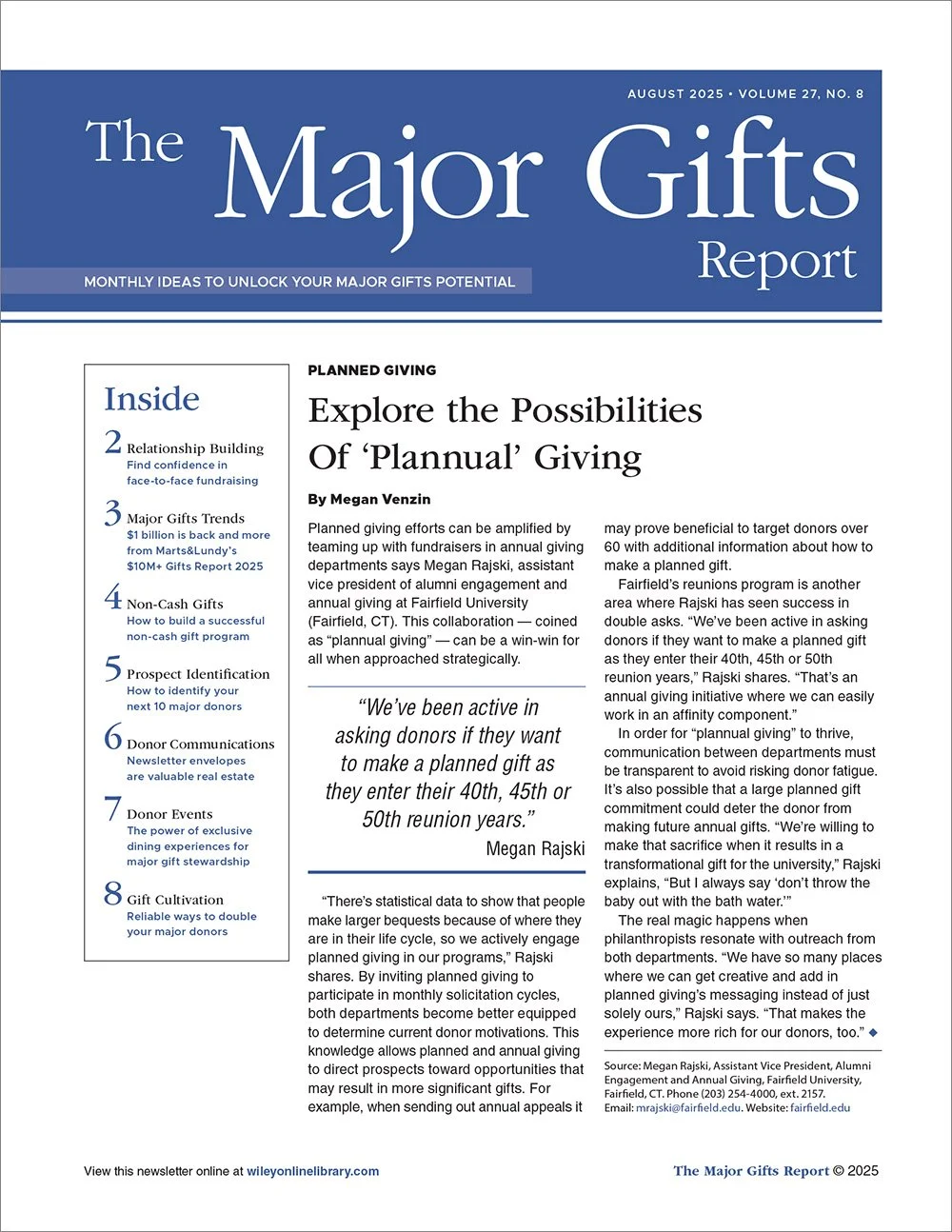
Find Confidence in Face-to-Face Fundraising
The Major Gifts Report. Read the article on deep connections that lead to better fundraising outcomes.
I am delighted to have been quoted in The Major Gifts Report. Read the article on page 2 for insights on deep connections that lead to better fundraising outcomes.
TO VIEW, CLICK ON THE ICON BELOW
Modernizing the Donor Pyramid YouTube Discussion
VISIONALITY's Katie Pearson discusses updates to the "Donor Pyramid" with Lauren Trujillo and Patricia Schwartz.
VISIONALITY's Katie Pearson discusses updates to the "Donor Pyramid" with Lauren Trujillo and Patricia Schwartz.
You don’t play the ‘new card.’
I'm delighted to announce that, because I do Onboarding Coaching as an area of my coaching practice, I was interviewed and quoted a few times in an article in the Huffington Post today about behavior when one is new on the job.
The following is an excerpt from an article at HUFFPOST. You can read the full article here: 7 Things You Should Never, Ever Do In Your First Week At A New Job
Patricia Schwartz, an executive coach who works with new hires, said playing the new card is a strategic advantage new hires should leverage.
“You can interact with people that you might feel more intimidated to interact with later,” she said.
But you need to be thoughtful about your first impression. Don’t just send every colleague the same generic message, because that “risks coming across as spammy,” Ng said.
When in doubt, Ng said you should focus on “building relationships with the people that you are already meeting and then introduce yourself to the people that you will soon work with, with a message like, ‘Hi! I’m _____ and I’m the new _____. Just thought I’d introduce myself!’”
The Nonprofit MBA Podcast
Building relationships for prosperity in the nonprofit sector requires a combination of self-awareness, and learning about your audience through asking insightful questions and developing the skill of attentive listening. Consequently, these practices strengthen connections with stakeholders and also help your organization fulfill its mission.

PRESS RELEASE
July 20, 2024
Building Relationships for Prosperity for Nonprofits With Patricia Schwartz
The Nonprofit MBA Podcast
Building relationships for prosperity in the nonprofit sector requires a combination of self-awareness, and learning about your audience through asking insightful questions and developing the skill of attentive listening. Consequently, these practices strengthen connections with stakeholders and also help your organization fulfill its mission. By prioritizing relationship building, your nonprofit can build a supportive community, secure long-term commitments, and ultimately achieve greater success in its endeavors. In today’s podcast, Patricia Schwartz from Company and Stephen Halasnik from Financing Solutions, a leading provider of business loans for nonprofits, discuss relationship building for prosperity for your nonprofit.
Read an Executive Summary or Listen to the Podcast HERE: Building Relationships for Prosperity for Nonprofits
About Our Guest, Patricia Schwartz from Company
Patricia Rachel Schwartz MA, MCC, NBC-HWC is an executive coach and major gifts coach. She has over 40 years of experience in leadership development, nonprofit development and management - locally, nationally and internationally, and she’s been an Executive Coach and Facilitator for over 20 years. As a Master Certified Coach (MCC) she is one of only 4% of coaches worldwide who’ve achieved this credential. She is also a Certified Team Coach, Certified Strengths Coach, National Board of Medical Examiners Certified Health & Wellness Coach and holds an M.A. Intercultural Management. Patricia has worked with over 3,500 leaders across sectors and industries and her background is in executive leadership in the business and nonprofit sectors. She’s raised over 12 million dollars for nonprofits.
Learn About Stephen Halasnik, The Nonprofit MBA Podcast, and Financing Solutions
Stephen Halasnik co-founded Financing Solutions, the leading provider of lines of credit for nonprofits and church financing. The credit line program for nonprofits & churches is fast, easy, inexpensive, and costs nothing to set up, making it a great backup plan when cash flow is temporarily down. Mr. Halasnik is also the host of the popular Nonprofit MBA Podcast. The podcast brings experts to discuss fundraising, nonprofit grants, executive director leadership, nonprofit boards, and other important topics. You can learn more about the nonprofit line of credit program here or call 862-207-4118.
THRIVING ORGANIZATION, THRIVING MEMBERS: A COACH’S PERSPECTIVE
We all need places where we feel part of things, where we have good experiences. The positive feelings I have with AWC caused me to want to contribute my time. As a result, I have led workshops, shared ideas with small groups, helped to create an ongoing accountability support group, and shared my thoughts with the leadership on what more we could do to engage members.
I started attending my local AWC chapter several years ago. I went to a few meetings to see what it was like. I wondered, who were these ‘women in communications’? What did it mean or include to be ‘in communications’? I wondered, was this me? I took stock and recognized that I spend a significant portion of my day in the communication process; writing, teaching, coaching, training, facilitating, presenting, and preparing related materials.
I felt welcome because of the positive atmosphere of the meetings. I experienced a relaxed sense of belonging, creativity and support. I felt encouraged to participate. It turns out this is what I was looking for in a professional group.
As a member of AWC for the past few years, I find that my strengths are supported at meetings through the sense of connectedness, positivity, acceptance, creativity, and learning. I naturally flourish as I contribute.
We all need places where we feel part of things, where we have good experiences. The positive feelings I have with AWC caused me to want to contribute my time. As a result, I have led workshops, shared ideas with small groups, helped to create an ongoing accountability support group, and shared my thoughts with the leadership on what more we could do to engage members.
We are all very good at supporting others and that helps AWC thrive. How can we direct that same kind of energy that we direct to others, toward ourselves? How can we build on these good experiences especially during this strange period where it’s not as easy to connect with other members between meetings?
Here are 3 things I’ve tried myself and with many clients over the years that I find helpful for supporting ourselves to express our best qualities in our daily lives. Perhaps you will find something here that’s beneficial. There is one activity to start your day, one to end your day and one for connecting with others around projects and accountability.
Start your day in good shape
Make a list of 3 or more positive qualities (like focus, kindness, creativity for example) that you’d like to have that day and then write out an example of when you’ve demonstrated each of those qualities in your life. Remember how it felt in each situation where you expressed those qualities, and let yourself savor those feelings. This will change your perspective on yourself. It will help you appreciate and recognize yourself. It will even help you think more clearly! Then start your day.
End your day with appreciation
At the end of the day, write out 3 things that went well and why each went well; especially what part you played in them going well. This is aptly called the What Went Well Exercise. It has been deeply researched and has positive effects on our wellbeing. You can find out more about this in the book Flourish, by Martin Seligman.
Surround yourself with support
Find 3-6 other people who you’ve met at AWC to form an accountability group. This is great for anyone working on a project that you’re energized about. It helps you think through what you need to do, get ideas, resources and support from others. Not only that, you’ll have more structure such as deadlines with accountability. It doesn’t matter if the project is in your own business or practice, or if it’s for the organization where you’re an employee. It can also be for personal projects. An important side benefit is the enhanced relationships that naturally occur in groups like these. The concept comes from mastermind groups, where 2+ minds are better than one!
Here are some how-to ideas for organizing this:
See if there is one other person in your AWC group who’d like to do this with you.
Put your heads together and come up with about 6-10 people you could initially ask to participate with you. For a range of reasons, it will be the right thing for some and not the right thing for others. If you start with a list of more people than you need, you will likely end up with enough to form a small group; 4-6 is a good number so there are enough to generate ideas for each person.
Determine any important ground rules that you can present for everyone to agree to, such as confidentiality, focus on ourselves, put phones away, etc.
Decide on a one hour-ish agenda (I like 75 minutes)
The agenda might include an uplifting and focused brief opening, a check report on how your actions went from last meeting, a chance to share something you’d like ideas/feedback/brainstorm help on, a round to state action commitments, and an inspiring closing.
Once you have definite interest from 4-6 people hold an informational meeting, even if it needs to be on zoom/videoconference. (Some people will drop away right away and others will stay; still others will suggest someone.)
Decide how often you’d like to meet, at least at first. This may change later. (I like every 2 or 3 weeks so there’s time to do the action steps I committed to.)
Share the agenda you came up with
Choose a facilitator for the first actual meeting- and then plan to rotate at each subsequent meeting.
Suggest people bring paper to note the actions that they and others committed to. This creates the accountability. The power of writing things down!
When you have your confirmed participants hold your first accountability meeting and enjoy the results! If you have questions feel free to email me at Patricia@PatriciaSchwartz.com and I can send you some examples of materials.
I had not initially thought of my work as an executive coach, facilitator, trainer and accidental author as falling specifically under communications, even though I did a lot of communicating in my work. I’m a prime example of the exponential impact of a welcoming positive environment for bringing out our best. Let’s use that same energy to support ourselves between meetings to extend the impact of AWC, to keep us thriving in our personal and professional lives.
To assess and help you maximize your level of thriving, here is a free tool on the homepage of my website: https://www.patriciaschwartz.com/
Influencing Your Audience, Part 1: Stories vs Statistics
Have you ever walked up to the podium to deliver a PowerPoint presentation, only to discover that the projector suddenly wouldn’t function and you couldn’t deliver it as planned?
Thinking On Your Feet

Have you ever walked up to the podium to deliver a PowerPoint presentation, only to discover that the projector suddenly wouldn’t function and you couldn’t deliver it as planned? What would you do if this happened to you?
This happened to a colleague of mine – we’ll call her Suzanne. After accepting the reality of the situation, Suzanne thought on her feet and decided to tell stories related to the slides she was going to show. She even pretended to click through the slides as if they were there and, via her words, painted a picture of what each slide was about. She captured the imagination of her audience. At the end of the meeting, many people came up to her to say it was one of the best presentations they had ever had in their business association!
It’s said that many things are invented or discovered accidentally due to an “error.” The fact that stories work to engage and communicate with an audience – even when connected to something as commonplace as a PowerPoint – is very instructive.
The Power of Storytelling

Storytelling has the potential to draw in huge amounts of business and revenue – just look at Hollywood and the publishing industry. Regardless of how your presentation is structured, stories will help get your message across and influence your audience.
Let’s say you’re presenting new policies to employees, a new promotion to clients, or your organization’s vision to a group of stakeholders. People won’t respond well to dry facts and statistics, but they will get engaged in a good story. Quicker than you can say “the plot thickens,” your audience will understand the message you are trying to get across. When a story is the basis of your presentation, important facts and statistics become the interesting details, which lend credibility to your story.
Becoming A Storyteller
To increase your effectiveness as a business leader, it will serve you to become an effective storyteller.
But how do you come up with a story? One method is to start with a positive experience related to your presentation topic/product/service/organization/etc. It might be an experience that you had, a story that you heard from someone else, or something that happened to a customer/client. (To gather stories from customers or clients, consider asking them directly about their best experience with your product/service/organization/team/etc. Beyond providing you with a story, this will help you engage with your business’s target audience to receive feedback about what works for them.)

“ABC Freedom” (name changed, as well as other descriptions, to protect anonymity), a company that sells natural weight loss products via health food stores, had a great experience with this method.
Rob, the head of the business development division, was speaking with the head buyer for a chain of health food stores. Rob told the buyer the story of a customer, Michael, a professional who had struggled for decades to control his weight. Michael finally succeeded in losing 40 pounds and credited his success, as well as the positive life changes that resulted, to ABC Freedom’s weight loss products!
This story helped give the buyer a reason for his chain of stores to carry the product – not because a salesperson promised him that his product should work, but because he heard a story of a real person who had used it to positively change his life. Of course, Rob also provided the relevant facts and statistics, but these were supplementary, rather than central, to his presentation. Rob used Michael’s story to represent the company’s vision and values related to what they do – to help their customers “find freedom to pursue the life of their dreams.”
Creating Your Story
Rob created his story by asking Michael the following questions:
- “What was your life like before you found our product? What were your struggles and challenges?”
- “What happened when you found our product? Was there a moment when you knew something positive was happening for you?”
- “How has this success affected your life?”
The answers to these questions naturally form the structure of a story: Question 1 explains the person’s background and motivations; Question 2 is the story’s climax, showing a turning point which distinguishes life before the product from life after the product; Question 3 resolves the story, presenting a happy ending which results from positive experience with the product.
Consider using a similar approach when creating a story for your own business.
How I Can Help
If you need help creating your story, I’d be glad to assist you. With over 35 years of experience in leadership and management, I can help you develop techniques to better connect with your customers, clients, and employees. If you’re interested in a FREE 30-minute consultation, please call 805-965-8595
Learning from Feedback, Part 1: Developing Emotional Intelligence
Almost all of us have heard feedback like this at some point: “I think you did a great job, but…”
The Common Response to Feedback

It can be stressful to receive feedback, even when it is mostly positive.
Almost all of us have heard feedback like this at some point: “I think you did a great job, but…” Suddenly, it hardly matters that we “did a great job” – we’re just anxiously waiting to hear what will follow the “but.”
This anxious response to feedback is common. Therapist, Leon F Seltzer, Ph.D. suggests that “[t]he ability to take criticism in stride, it seems, is nearly universally elusive,” but emphasizes that “as common and understandable as this felt vulnerability may be, we hardly need to be subjugated by it indefinitely.”
This is encouraging news! By overcoming our instinctive fearful response, we can begin to learn from feedback rather than defend ourselves against it. We can develop a mindset in which it does not bother us, but rather gives us direction and encouragement for making improvements.
To develop this forward-thinking mindset, it is important to understand amygdala hijack and how this psychological phenomenon affects us when we become anxious.
What Is Amygdala Hijack?

The human brain, shown from the side (left) and front (right), with the amygdala highlighted in red.
The human brain, shown from the side (left) and front (right), with the amygdala highlighted in red.
The amygdala is the part of our brain that serves as “the integrative center for emotions, emotional behavior, and motivation.” When we perceive a threat – physical or psychological – the amygdala “hijacks” our brain, overriding our rationality and making us respond emotionally.
Dr. Daniel Goleman – a world-renowned author, psychologist, and science journalist – explains that “emotions make us pay attention right now – this is important – and give us an immediate action plan without having to think twice.”
This “right now” response is what most of us experience when we hear feedback. We perceive a threat to our self-identity or self-worth, and thus want a solution now. Rather than listen to feedback and consider it rationally, we are inclined to either fight it or flee it. (For more on this phenomenon, see Fight or Flight).
According to Goleman, this emotional reaction is sudden and often seems inappropriate in hindsight. But, how can we overcome this response and act with reason rather than emotion?
This requires emotional intelligence.
What Is Emotional Intelligence?
Psychology Today explains emotional intelligence as “the ability to identify and manage your own emotions and the emotions of others.” The difference between having higher and lower emotional intelligence lies in how we respond to our emotions.
People with higher emotional intelligence are aware of their emotions and can effectively manage them, while those with lower emotional intelligence are controlled by their emotions.
What does emotional intelligence look like in practice?

Goleman explains that “[t]he emotionally intelligent person is engaged, focused,
motivated
and attentive, and matches these skills to the situation.” Leaders who are emotionally intelligent can use traits like humor and empathy to “de-escalate conflict and help move toward a working consensus of how to handle the problem.”
The emotionally intelligent person is not excessively preoccupied with the past, present, or the future – they are able to thoughtfully reflect on the past, assess the needs of the present situation, and use this to work toward effective solutions for the future.
When we can effectively manage our emotions, it is easier to respond to feedback – even when it is given in a less than skillful way.
Would You Like to Improve Your Emotional Intelligence?
I have coached clients in-depth on this topic and am certified through Multi-Health Systems Inc. to administer and interpret the EQ-i 2.0 and EQ 360 Emotional Intelligence Assessments.
You don’t have to let your emotions override your rationality! As a certified Executive Coach, I can help you stay level-headed in demanding situations, so that you can confidently make rational, well-informed decisions when they matter most.
In Learning from Feedback, Part 2, we will discuss skillful ways to give feedback and the importance of developing a forward-thinking mindset.
For a free consultation on your goals and dreams, please call 805-965-8595
Learning from Feedback, Part 2: From Feedback to Feedforward
One of the most useful results of developing emotional intelligence is the ability to understand the emotions of those around us.
How Emotional Intelligence Helps Communication
One of the most useful results of developing emotional intelligence is the ability to understand the emotions of those around us. By understanding these emotions, we can begin to pick-up on the subtleties of peoples’ reactions – What compliments engage them? What language makes them respond positively or negatively?
Whether our work demands that we lead, follow, or collaborate; give orders, receive them, or share leadership, the ability to understand and respond to the emotions of those we work with is integral to effective workplace communication.
Communication in the Workplace

In the workplace, communication may take the form of feedback, whether formal or informal. Employees need to know if their work is in line with the goals set by their leaders, and leaders need to know if their guidance is effectively moving their team forward.
However, Marshall Goldsmith, recognized as one of the top leadership thinkers in the world, explains that there is a fundamental problem with feedback: “It focuses on the past, on what has already occurred—not on the infinite variety of opportunities that can happen in the future. As such, feedback can be limited and static, as opposed to expansive and dynamic.”
From Feedback to Feedforward
Goldsmith suggests replacing most instances of feedback with feedforward.
Feedforward is similar to feedback in that it encourages positive changes in behavior. It differs, however, in that it deals solely with what needs to happen in the future.
Goldsmith describes a simple group activity to practice feedforward:
In pairs, participants take turns sharing a behavior that they would like to improve and receiving feedforward from their partner. This feedforward must give advice for future actions which can bring about the desired improvement, and cannot mention the past. While receiving feedforward, participants cannot comment on the feedforward – only listen attentively and take note of the advice. They then thank their partner for the feedforward, and the roles are reversed. (For a full outline of the activity, visit Goldsmith’s website here).

While receiving feedback can often be stressful and demoralizing, Goldsmith reports that when participants describe the feedforward activity, “the words provided are almost always extremely positive, such as ‘great’, ‘energizing’, ‘useful’, or ‘helpful.’ One of the most commonly-mentioned words is ‘fun!’”
In my coaching practice, I use feedforward with clients/leaders in three ways: I teach it to them, I use it in coaching them, and I request it from them in order to further align my work with their goals.
The Importance of a Forward-Thinking Mindset

Businessman finding the solution of a maze
Einstein is quoted as saying, “We cannot solve our problems with the same thinking we used when we created them.” Ruminating on the past does not solve problems – creating plans for progress does.
Feedforward aims at creating a forward-thinking mindset by establishing a goal for the future and outlining specific actions to make it a reality.
You may find yourself surrounded by people who focus on your past mistakes without offering ideas for improvement. If so, I would love to provide you with feedforward and help you develop a forward-thinking mindset. As a certified Executive Coach, I apply strength-based approaches to help you identify the strongest aspects of your character. By applying your strengths to your goals we create a vision of a future you want to be part of, and then I provide support to help you turn your vision into reality.
For a free consultation on your goals and dreams, please call 805-965-8595
Why Hire a Coach?
Imagine getting to where you want to be in your career or personal life; reaching that important goal you’ve had for a while!

Imagine getting to where you want to be in your career or personal life; reaching that important goal you’ve had for a while! A coach can support you on your path toward your greatest successes.
Here are 5 (more) reasons to hire a coach:
1 – You want to maximize your results in a fraction of the time that it would take to do it on your own!
You can try to go it alone, but that will take a lot longer than working with a coach-who helps you bring your goals into clear focus, set up actions to reach them, and remain on target to complete them. This is possible because a coach is not just a thinking partner, but an accountability partner- we help you set deadlines and keep to them!
For example, I’m coaching a V.P. from a large organization, and not long ago she was experiencing frustration and stress as a result of a complex situation at work. She sought out my services, and together we were able to make a plan with actionable steps. She has made considerable progress and now reports a sense of revitalization, clarity, and momentum!
2 – You want an outside viewpoint that is both knowledgeable and objective/impartial.
Wouldn’t it be great to have the ear and perspective of an experienced professional? Someone whose only stake in your decisions is your success? A coach is that person.
I coach executives and leaders who have nobody in their realm who will give them honest feedback or who can offer an objective perspective like a coach does. It is unfortunate that those in power often have less access to objective feedback, especially considering that leaders are actually more open to constructive criticism than followers are.
3 – You are facing a change and you want it to go well: a promotion or other career transition or a change in your personal life.
You want the change to go as smoothly as possible. A coach helps you reflect on the internal as well as external aspects of the change and create a game plan with accountability.
In most changes, we need to go through some internal transitions, complete additional tasks related to the transition, all while continuing to accomplish important tasks in our work and life. The uncertainty and uprooting nature of change can create added stress in an already busy life.
I help my clients think about what is ending and how they can best approach it, what they need in order to prepare for their next step, and how to launch something new in a way that supports them individually and benefits everyone involved.
For example, a recent client set up a 90-day transition plan for a career move. This significantly reduced the stress associated with uncertainty and helped him feel a greater sense of control.
4 – You have reached a plateau and you want to consider your next move!
You want to think through options for your future with an experienced, skilled practitioner. A coach is a thought and accountability partner who encourages you to fully explore possibilities, develop a vision of you at your best, and create an overall plan that consists of actionable steps. With your vision as a guide, and by following your action steps, you will make progress towards realizing your full potential.
5 – You wish to further develop your leadership skills to not only better yourself and your career, but to be able to better motivate those around you.
You want to have a more positive impact in your work, with your team, and/or in your personal life, but where do you start? A coach helps you become more aware of what’s working well that you are currently doing, what your current mindset is, and what you want to do differently. This process occurs via conversation and also with the help of excellent leadership strengths and skills assessments.
Using assessments we evaluate your goals and set up plans and small steps for learning new ways of leading at work and in your life. I am certified in and use various leadership assessments such as the EQi 2.0 and 360, the Myers-Briggs, the CPI 260, the Strengthsfinder 2.0 and the Leadership Practices Inventory (LPI).
For a free consultation on your goals and dreams, please call 805-965-8595
Walking in the Workplace: Easy Steps for Improving Creativity and Wellbeing
Have you ever found yourself struggling with a new idea at work, thinking “I just need to get up and move my legs”?

Have you ever found yourself struggling with a new idea at work, thinking “I just need to get up and move my legs”? Your body may have been telling you something.
New studies are finding that spending our workday at a desk and our leisure time on a couch isn’t just bad for our physical health – it negatively impacts our mental wellbeing and slows our productivity at work. The key to improving both our health and our creativity might be as simple as getting up and going for a walk.
A recent study from Stanford University tested the relationship between walking and thinking creatively. Researchers found that, compared to sitting, walking increased participants’ abilities to generate new ideas and explore a greater number of possible solutions to problems, even after they had stopped walking. It did not matter whether participants walked on a treadmill or around Stanford’s beautiful campus – “the act of walking itself, and not the environment, was the main factor” (Stanford Report).
This finding sounds appealing, but does it hold-up in an actual workplace? Business owner, John Rampton, has good reason to believe so. In an article for Entrepreneur, Rampton shared that his company had recently experienced a 30% increase in productivity and profitability. How? By requiring all employees to go for two 15 minute walks every day (in addition to regular breaks). When they returned from their walks, the employees completed tasks both more accurately and more quickly.
Try It Yourself!
It would be wonderful if more workplaces followed Rampton’s example and set aside time for walking breaks, but the reality is that most don’t. Thankfully, incorporating walking into your daily routine is easy if you just make a few small changes to your habits!
Rest breaks at work are a great time to get in a bit of light exercise. If you only use your break time to transition from sitting at a desk in front of a computer screen to sitting at a lunch table in front of your phone screen, how much of a break are you truly getting? Not much of one! Instead, try using this time to get a break from responding to electronic stimuli and being confined to a small space by taking a walk. Even if you need this time to make phone calls, do it on the move!
You can also adapt your workplace to be more movement-friendly. If you have a printer at your work desk, consider moving it to another room – you’ll free up space at your desk and will get to stretch your legs every time you go to retrieve your documents. If you need to speak with a coworker or employer about work matters, consider meeting with them in person rather than contacting them via phone or email – aside from the benefits of getting in a quick walk, you’ll also be able to communicate more effectively and efficiently when your conversation isn’t mediated by an electronic device.
Throughout the workday, these small walking trips really add up!
But walking isn’t just about being more productive and getting more physical exercise – it’s been shown to improve mental wellbeing as well. According to the UK’s National Health Services website, even light exercise is effective at protecting people from depression and anxiety, and can alleviate these symptoms in people who already suffer from them. Scientific evidence suggests that exercise causes chemical changes in our brains which create “a sense of greater self-esteem, self-control and the ability to rise to a challenge” (National Health Services).
Making a Change
Walking is easy – the hard part is convincing yourself to take the first steps. As a certified executive coach, I would love to help you move your life forward!
For close to 20 years I have been helping people create compelling visions for the future, and supporting them as they turn these ideas into plans and actions. I help you discover your own wellspring of wellbeing, which you can draw from as you move toward even greater wellbeing in your personal and professional life.
I hope that you have found this post helpful and encouraging – the most important part now is to try these tips for yourself. Personally, in addition to walking in my office while I’m on the phone I’ve been leaving my office twice a day to take a longer walk, and have definitely noticed an improvement in my creativity during the work day!
Incorporating more exercise into your daily life doesn’t need to be daunting or stressful – it’s (literally) just a series of small steps! I’d love to hear about the new ways you find to bring exercise into your daily life and the positive results you experience from it!!!
Connecting the Dots on Our Happiness Potential: What’s Mindset Got To Do With It?
If you would like to be happier and healthier by doing only one small thing differently, this information is for you.

If you would like to be happier and healthier by doing only one small thing differently, this information is for you. Before talking about how your mindset affects your life, and what you can do about it, here’s a definition of the term according to Merriam Webster- “a particular way of thinking: a person’s attitude or set of opinions about something”.
According to happiness researcher Sonja Lyubomirsky, 50% of our happiness is set genetically, 10% is situational and 40% is under our control. What does “under our control” mean? This 40% is directly related to our perspective/ our mindset.
In addition, research by Dr. John Gottman and others such as Dr. Barbara Fredrickson shows that in order to feel more positive vs negative, there are things we can do. We need to have many more positive feelings and experiences than negative ones.
Dr. Gottman says we need 5 positives to every negative in our relationships and Dr. Fredrickson says at least 3 positives to one negative. So, taking the average, to be in the range, I’m going with at least 4 positives to one negative, a 4:1 or 80/20 ratio.
When I think about the nature of a positive feeling or experience, it’s usually something I enjoy thinking about or want to go “toward” (vs away from). Like looking forward to seeing a friend I haven’t seen in a long time, or being satisfied with a how a project went. Others have spoken about the idea of toward and away over the years, and I’m building on their ideas here.
When I think about the nature of a negative feeling or experience, it is usually something that is in some way a difficult problem, an obstacle, or something I want to move “away” from. This is also what I hear from my clients and read in the research. We don’t enjoy thinking about problems, but of course we need to think about them to a certain extent in order to resolve them.
Both positives and negatives are part of life. There are things we want to go towards in our thinking and our life, as well as things we want to go away from in our thinking and our life.
How To Get Happier:
“”

One way to achieve the 4:1 or 80/20 positive ratio (in our thinking first, then our actions) is to use the below diagram, fill in the 4 “toward” areas with what you want, look forward to, are grateful for or simply feel good about, and the “away” area with one thing you don’t want and therefore are going “away” from.
After you fill it out, look at your Mindset “pie” every day to help you feel positive and to encourage you to take steps in the direction of what you want. Positive thoughts about what you want, are going towards, are grateful for or feel good about will create positive emotions. This will give you energy and naturally leads to positively oriented action.
Spend as much action time as possible (80% of your time is a goal) on the 80% of things you are going towards. Use the Mindset pie to decide on your action steps. You will need to manage the 20%. Sometimes, but not always, the 20% becomes irrelevant or it changes in unexpected positive ways as you shift.
It’s helpful in resolving the 20%, to flip it around to what you want from what you don’t want. That gives you something to go toward, rather than away from. For example, if you have a problem to solve, think about the best case solution and how you could create that. Having support to make this 80/20 adjustment is also very helpful. As a coach, I can help you with this process.
As you shift your mindset little by little to spending at least 80% of your thoughts on what is going well and what you look forward to, you will notice positive shifts in your daily experience. I’d like to hear from you about it!!
Step 1 of The Wellspring Method℠ Program
This coaching activity integrates Positive Psychology, Appreciative Inquiry, and Strengths Based Approaches in a way that directly taps your own potential
Fuel Your Best Self and Build Resilience

Welcome to The Wellspring Method℠ 5 Step Program. This coaching activity integrates Positive Psychology, Appreciative Inquiry, and Strengths Based Approaches in a way that directly taps your own potential, while increasing your resilience.
A poster presentation of The Wellspring Method℠ embodied coaching intervention. Photo taken at the Fourth World Congress on Positive Psychology.
The Wellspring Method℠ 5 Step Program is part of a 4 to 18 month coaching program where we determine your strengths-based vision, activate it with this exercise, and co-create it in the world with me as your thought partner and accountability partner.
Experiencing the method provides an opportunity to identify/renew/build on your strengths, values and purpose in this chapter of your life and to know the powerful wellspring of possibilities that fuels it. It is a reference point for resilience that you can visit regularly.
Assumptions
These are the powerful beliefs and assertions that support The Wellspring Method℠ Approach:
- Knowing ourselves at our best (our positive core) is essential.
- It is not enough to know ourselves at our best, we must bring our positive core into the world.
- This is our purpose-to share our gifts with the world.
- Standing “on purpose” activates a powerful wellspring of support in terms of possibilities, ideas, creativity, perspective.
- We are free to visit this wellspring any time we choose, as it is always available to us.
Step 1: Your Peak Moment

Take a moment to scan best moments in your life and work. Recall a particular best experience that you were good at and you loved. Remember it in detail-who was there, how did you feel?
Now stand up and imagine that you are transported to a beach and a perfect drawing stick appears in your hand. Use the stick to draw the outline of 2 partially overlapping circles in front of you, where the intersection of the circles is right in front of you and big enough for you to step into.
Step forward into the intersection; explore it with your 5 senses in 3D. What feelings do you have? This is your positive core. Experience the confidence and positive emotions that come up. Reflect and receive. Note what your strongest strengths and greatest passions are, that combined to create your peak experience.
Please contact me if you’d like a free consultation on your goals and how this process may help you: 805-965-8595
Step 2 of The Wellspring Method℠ Program
Welcome to Step 2
Fuel Your Best Self and Build Resilience
If you have not read step 1, please go do so first.
Welcome to Step 2 of The Wellspring Method℠ 5 Step Program.
This coaching activity integrates Positive Psychology, Appreciative Inquiry, and Strengths Based Approaches in a way that directly taps your own potential, while increasing your resilience.
Step 2: Your Purpose and Wellspring

While still standing in the intersection of the 2 circles, with your strengths and passions in mind, take the stick and draw a 3rd circle in the imaginary sand so that is overlaps your 2 circles like the image above, forming a Venn diagram. Step forward to this smaller intersection of your wellspring and purpose, the place from which you share your gifts. What the world needs is for you to share your gifts by being the person you recall in your best experience and feeling those positive feelings.
This is where you receive inspiration to express your best self in the world. It’s where your wellspring of possibility for expression originates. You are in direct contact with your source of possibility.
Step 3
Please contact me if you’d like a free consultation on your goals and how this process may help you: 805-965-8595.
Step 3 of The Wellspring Method℠ Program
Welcome to Step 3
Fuel Your Best Self and Build Resilience
If you have not read step 1 and step 2, please do so first.
Welcome to Step 3 of The Wellspring Method℠ 5 Step experiential program. This coaching activity integrates Positive Psychology, Appreciative Inquiry, and Strengths Based Approaches in a way that directly taps your own potential, while increasing your resilience.
Step 3: Expand Your Wellspring

Still standing, in your imagination, enlarge the intersection of the 3 circles where you are standing until it is the right size for you. Do a 5 senses, 3D exploration with your hands, your feet, your eyes and ears. How big is the space? What does it look like in your wellspring zone? What sounds do you hear? What feelings do you have, physically and emotionally? Take in the inspiration and information for your vision. Feel your purpose, see your vision, and experience the confidence and desire to share your gifts.
If you are doing this independently, (without a coach) after this experience you may want to share it with a friend, or write your reflections in a journal to help deepen, clarify and illuminate your insights and experience.
Please contact me if you’d like a free consultation on your goals and how this process may help you: 805-965-8595
Step 4 of The Wellspring Method℠ Program
Welcome to Step 4
Fuel Your Best Self and Build Resilience
If you have not read step 1 through 3, please do so first.
Welcome to Step 4 of The Wellspring Method℠ 5 Step experiential program. This coaching activity integrates Positive Psychology, Appreciative Inquiry, and Strengths Based Approaches in a way that directly taps your own potential, while increasing your resilience.
Step 4: Live In and From Your Wellspring

Step away but allow the intersection to move with you. As part of your reflection on the experience, you may want to fill in your own blank image of the wellspring intersection with words, images, etc. Keep this representation where you can see it daily.
You may also want to write a vision statement describing what it is like when you are living your vision, and purpose, being fed by your wellspring.
Step 5
Please contact me if you’d like a free consultation on your goals and how this process may help you: 805-965-8595